Showing posts with label battleships. Show all posts

Monday, June 14, 2010

History Nerdiness Takes No Vacations, Part 9

The Battle of Dunkirk famously displayed the limitations of air power.  The Germans had the British Expeditionary Force pushed against the North Sea.  Rather than ordering the army to destroy the British to the man, Hitler allowed Goering to attempt to destroy the British using the Luftwaffe.

He failed.  Some 340,000 troops escaped from the continent, possibly saving the war for England in the early days.[1]  But the failure at Dunkirk should not have been taken as a failure of air power as a whole.

The fall of France put Britain in a bind.  Everyone who has some knowledge of World War II has at least a passing knowledge of the Battle of Britain and the privations placed upon the British citizenry over the course of the bombing campaign.  But there was a much larger strategic difficulty in play that few people mention.

The fall of France meant that Britain could no longer rely on the French Navy to contain the Italian Regia Marina.  The Regia Marina sat astride the British supply lines that stretched the breadth of the Mediterranean from Gibraltar to the all-important bases surrounding the Suez Canal in Egypt.  Italy’s main fleet, based at Taranto in the heel of the Italian peninsula, simply had to be there to cause problems.

This is a concept known as a “fleet in being.”  The general idea of the fleet in being is that a relatively weak fleet can deny the use of the sea and tie down enemy forces without ever having to engage in battle and risk destruction.  No better example of a fleet in being can be found than the German High Seas Fleet in the First World War.  The High Seas Fleet rarely left port, spent the vast majority of the war boxed up in Wilhelmshaven, and yet managed to deny the North Sea to the British and forced the Grand Fleet to remain at Scapa Flow, rather than attempt to engage in any adventurism away from northern Europe.

During World War II the Axis powers in Europe operated their surface navies primarily as fleets in being.  The pocket battleships, along with the Scharnhorst and Gneisenau, regularly sortied, forcing the British to divert precious naval resources to track them.  The pocket battleship Graf Spee was an excellent example of this.  In the weeks preceding the Battle of the River Plate and Graf Spee’s subsequent scuttling, the British had nine different ship groups specifically hunting Graf Spee, including four aircraft carriers, three battleships, and two battlecruisers.

As long as the Regia Marina had a powerful fleet in the port of Taranto, the British were in trouble.  The Royal Navy could have taken on the entire Regia Marina and the entire Kreigsmarine in open battle.  But there was to be no Trafalgar.  There wasn’t even to be a Jutland.

The idea of assaulting Taranto directly was out the window, too.  One of the key aspects of the fleet in being is the simple idea that the fleet in port is relatively safe from opposing warships.  Throughout history this had been more-or-less true.  An enemy generally had to take a port in order to reach the ships berthed therein.

But the British Mediterranean Fleet had something that no previous naval commander had been able to claim: airplanes.  Specifically, Admiral Andrew B. Cunningham[2] had a force of 21 obsolescent Fairey Swordfish attack biplanes using specially modified air-dropped torpedoes.  On the night of November 11-12, 1940, the Swordfish of the Mediterranean Fleet attacked Taranto.  When the dust settled, the Littorio and Caio Duilio were heavily damaged and the Conte di Cavour had been sunk.

Taranto did not destroy the Regia Marina, but it did mean that the fleet was diminished for the Battle of Spartivento later that month and Cape Matapan in March of 1941.  While not decisive in and of itself, the Battle of Taranto had lasting repercussions in the Mediterranean.  The results were also studied with much interest by Japanese military planners on the other side of the world.  But the next move still went to the British.

In the spring of 1941 the battleship Bismarck attempted to break out in to the Atlantic Ocean.  The British could not have that.  The first ships to engage Bismarck were the HMS Hood, the Royal Navy’s pride, and HMS Prince of Wales, the newest of the King George V-class of battleships on the morning of May 26th.  The first battle did not go so well for the British.  Hood was sunk, Prince of Wales forced to retire.  The Bismarck broke out in to the Atlantic.

That evening several Swordfish bombers from the HMS Victorious hit Bismarck, opening wounds quickly repaired after the battle with Hood and Prince of Wales.  Bismarck was forced to slow to 16 knots.  On the 26th Swordfish launched from the Ark Royal again hit Bismarck, jamming the battleship’s rudder.  The great battleship was now effectively unmaneuverable.  It was only a matter of time before the ship would be destroyed.

On the morning of May 27th the King George V and the Rodney closed on Bismarck, accompanied by the heavy cruisers Norfolk and Dorsetshire.  Bismarck was ultimately sunk the traditional way.  But it’s entirely possible that the sinking would not have happened were it not for carrier-launched aircraft.

On December 7th, 1941 the demonstration of the strategic use of air power moved out of British hands.  The Japanese attacked Pearl Harbor.  Where the British had launched 21 aircraft from two relatively small aircraft carriers against Taranto, the Japanese launched nearly twenty times that many from six large fleet carriers.[3]  We all know what happened on December 7th.

Less well known, however, is what happened three days later off the coast of Malaya.  The British dispatched the battleship Prince of Wales and the battlecruiser Repulse to the Pacific to show the flag and “overawe” the Japanese.  This force, known as Force Z, was also supposed to include the new carrier HMS Indomitable, but that ship had run aground.

One of the most expensive things to provide is an object lesson.  Force Z provided an unexpected one when the Japanese jumped the fleet and sunk it.  No Japanese surface ships were involved in the engagement at all.

Over the course of three days the Japanese effectively swept the Pacific of all Anglo-American battleships without firing a single gun from a ship of their own.  Admiral Yamamoto, architect of the attack on Pearl Harbor, did not necessarily see this as reason to celebrate.  He would prophetically declare that the attack on Pearl Harbor had awakened “a sleeping giant.”

But Yamamoto had done far more than that.  In removing the battleship fleet in Pearl Harbor from the US Navy’s short-term planning, Yamamoto ushered in the next evolution in naval combat.  Three American Pacific capital ships weren’t in Pearl Harbor that Sunday morning: the Enterprise, Lexington, and Saratoga.  When the United States struck back it wasn’t with 16” guns fired at a range of 20 miles.  It was with torpedoes and bombs dropped from aircraft.

The story of the Pacific war is one of aircraft carriers.  The iconic early war battles: Coral Sea and Midway were fought at aircraft range, not gun range.  The Japanese superbattleship Musashi was sunk by aircraft during the Battle of Leyte Gulf.  One of the most lopsided battles in the Pacific war pitted a tiny force of four American escort carriers, two destroyers, and four destroyer escorts known as Taffy 3 against a Japanese force consisting of Yamato, Nagato, Kongo, Haruna, and escorts.  Taffy 3 won the day due to a combination of heroism, luck, and the ability of the force’s aircraft to harass the Japanese to the point of distraction with no worries about Japanese aircraft.[4]  Yamato was sunk by airplanes without ever reaching its final objective of beaching itself on the shores of Okinawa and destroying the invasion fleet.

There were, in fact, only two battleship engagements during the Pacific War.  In November of 1942 the battleships South Dakota and Washington engaged the Kirishima in a night engagement during the Guadalcanal campaign. Kirishima did not survive the battle.  During the Battle of Leyte Gulf the old battleships of Jesse Oldendorf’s detachment blocked the end of the Suriago Strait against the Japanese Southern Force.  Oldendorf’s command included the West Virginia, Maryland, Tennessee, California, and Pennsylvania, which had been salvaged from the wreckage of Pearl Harbor, as well as the Mississippi, which had been on the East Coast at the time.  The Japanese force included the Yamashiro and the Fuso.  But the Fuso had already been destroyed by torpedoes by the time the American battleships were even in range, so the last battleship combat in history was a 6:1 drubbing.

It’s fitting, I suppose, that the final battleship-to-battleship battle in history was an affair between obsolete warships of a previous generation.  The battleship was an anachronism by the end of the Second World War.

The final generation of battleships launched were the magnificent fast battleships, most notably the American Iowa-class ships.[5]  But this last generation of ships wasn’t valued for their main guns as much as they were for their huge AA batteries and their ability to keep up with fleet carriers.  No ship in the world could carry as much anti-aircraft weaponry as a battleship, so as a final line of defense they were invaluable, especially when the increasingly desperate Japanese began the kamikaze attacks as the war drew to its inevitable conclusion.

After World War II the battleship stuck around for a while.  It was still a prestige weapon and a potential deterrent.  At various times between the end of World War II and Desert Storm the Iowas were pulled out of retirement, renovated, and put back on the battle line.  But it wasn’t enemy battleships they were tasked with engaging.

In the Korean War, then again in Vietnam and, finally, in Desert Storm the Iowas (all but Missouri in Korea, the New Jersey in Vietnam, and Missouri and Wisconsin for Desert Storm) were brought to the line for their unparalleled ability to attack ground emplacements.  Those giant 16” guns have an impact that few other conventional weapons can claim.  They also possess an ability to loiter within range of a target that aircraft simply do not.  When combined with newer weapons, like Tomahawk cruise missile launchers, they were still terrifying weapons.

But maintaining battleships on the off chance they’ll be needed to shell enemy land installations is an investment with a very low rate of return.  So even the last of the battleships have been sent off to their final duty as museum ships.[6]

Mikasa, Yokosuka, Japan:


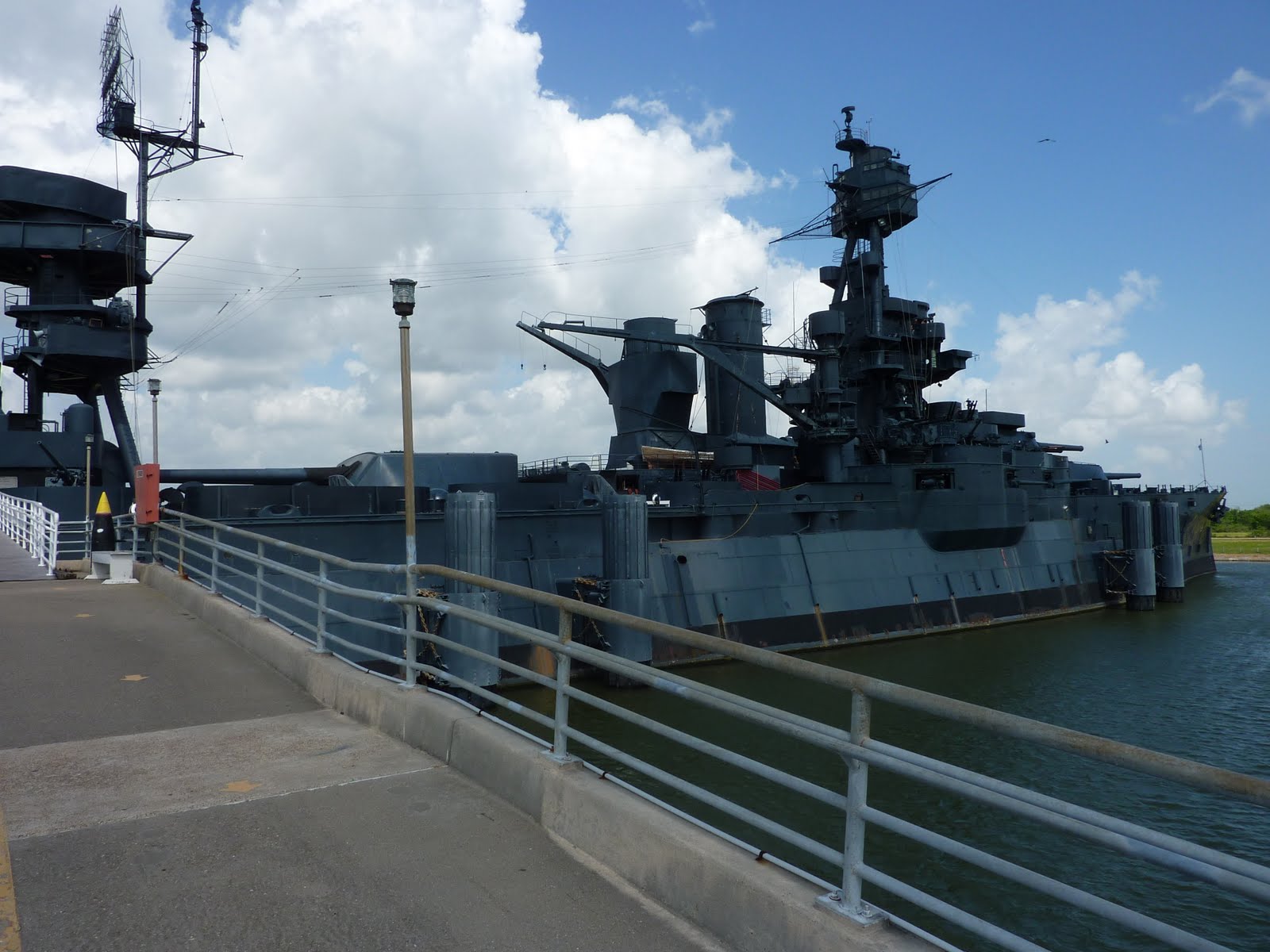
USS Texas, Houston, TX:


USS North Carolina, Wilmington, NC:


USS Alabama, Mobile, AL:


USS Massachusetts, Fall River, MA:


USS Iowa, US Navy Reserve fleet, Suisun Bay, CA:


USS New Jersey, Camden, NJ:


USS Missouri, Pearl Harbor, HI:


USS Wisconsin, Norfolk, VA:


---------------------------

[1]Goering made the same mistake again in North Africa.  The British held Malta, an island that sat directly between the tip of Italy and the North African coast.  Planes and ships sortied from Malta, cutting off the majority of supplies bound for the Afrika Korps.  Goering decided that Malta would capitulate under massive air assault.  It didn’t.  Goering: not too bright.

For a practically inhospitable rock, Malta played a pivotal role in the Mediterranean on many occasions.  The Knights of St. John (also known as the Knights Hospitaller) held the line against the onrushing Ottoman Empire during the critical century and a half between the fall of Constantinople and the Battle of Lepanto.  The simple accident of geography that put Malta in the middle of the narrowest passage between Italy and North Africa made the island far more important than it should have been.

[2]Nicknamed “ABC.”

[3]There’s a difference in naval theory to be seen here.  Britain, engaged as it was in the relatively confined spaces of the North Atlantic and the Mediterranean, didn’t see a need for large aircraft carriers.  The United States saw the aircraft carrier as a key way to project power across vast distances.  At the outset of World War II the biggest British carrier was Ark Royal, which carried 70 planes.  The rest of the British carriers had 50 or fewer aircraft.  The American Yorktowns and Lexingtons carried 90 aircraft.  Only the Ranger and Wasp had aircraft complements in the mid-70s.  Ranger was the first purpose-built American aircraft carrier and Wasp was a somewhat successful attempt to scale the 20,000-ton Yorktown-class carriers down to 15,000 tons to squeeze one more carrier out under the Washington Treaty tonnage limits.

[4]James Hornfischer’s Last Stand of the Tin Can Sailors.  Read it.

[5]The last battleship ever built was the HMS Vanguard, which was launched after the end of the war and scrapped in 1960.  Vanguard was the largest British battleship ever built, but was still only roughly on par with the Iowas, possessing a main armament of 8 15” guns.

[6]Although the USS Iowa is still looking for a home as of the last time I heard.

Thursday, June 10, 2010

History Nerdiness Takes No Vacations, Part 8

As the world rushed towards its second great war in a generation all of the talk was about battleships. Of course those who were talking about land war were also talking about the Maginot Line.

Germany had frightened the world by basically shirking the ship building limits imposed upon it by the Treaty of Versailles. At the tail-end of the ‘20s they began construction of the Deutschland, followed shortly by the Admiral Graf Spee and the Admiral Scheer. The three ships were supposed to match a 10,000 ton limit that allowed Germany a costal defense fleet. In reality the ships were about one-third above the limit in order to allow the mounting of a pair of triple 11” turrets. The German Navy defined them as “panzerschiffe” at first, but later redesignated them heavy cruisers.

The British called them “pocket battleships.”

In truth, other than the bit where they had an 11” main battery, the pocket battleships were nothing close to a battleship. By way of comparison, the Northampton-class heavy cruisers, the US Navy’s workhorses in the Pacific, were actually 3,000 tons lighter, armed with nine 8” guns, 1 more torpedo tube, a better AA suite, and were four knots faster. Both classes of ships were similarly protected, but the only place where the pocket battleships were absolutely better was in their secondary armament. But against a real battleship or a competently handled battlecruiser it would not have mattered at all.

Germany’s next attempt was much better. Had the Scharnhorst and the Gneisenau[1] been deployed at the Battle of Jutland they would have been the best ships in the engagement by a significant margin. The only reason they weren’t considered more powerful is because they were only armed with 11” main guns, a weapon that simply wasn’t to be fully respected in a world of 16” guns. The Bismarck and Tirpitz, however, with their eight 15” guns and 30 knot top speed were forces to be reckoned with. They were bigger, faster, and carried bigger guns and more armor than the British King George V-class (although the British ships had 10 14” guns, so the difference may well have been moot). The main belt on the German ships was slightly inferior, but that’s because the Germans never adopted the all-or-nothing design scheme of the American and British naval architecture at the time.

The Germans only managed to build the two super battleships of the Bismarck-class. The plan was for five, to be followed by the so-called H-class, ships ranging in the 60,000 ton, 16” gun range. When war broke out in 1939 the actual build plan was scrapped, but planning and refinement continued, until the point where the design for the ships ballooned to over 100,000 tons.  This is why engineers and architects should be kept constantly busy with actual projects.

In point of fact, the British Royal Navy that went in to WWII was not the Royal Navy that entered WWI. England went to war with all of seven post-WWI battleships in 1939: the four King George Vs, the two Nelsons[3], and the Hood. Other than that, Britain had the two Renown-class battlecruisers, the five Revenge-class battleships, and the four Queen Elizabeths. All had been upgraded between wars, but not to nearly the same degree as, say, the USS Texas, as the British felt an acute need to show the flag at their overseas outposts while the rest of the world’s navies had the luxury of laying their battle squadrons up for long periods of time. Either way, the British Navy of 1939 actually had fewer battleships and battlecruisers than the German High Seas Fleet deployed at Jutland.

Of course, the Kreigsmarine was no High Seas Fleet. Had all of Hitler’s plans come to fruition there might have been more of a problem. But Britain’s plan was to basically turn the Mediterranean over to the French and concentrate on the North Sea, Atlantic, and countering the Japanese in the Pacific if necessary. But, of course, if the “if necessary” came along, there was a good chance the US Navy would be involved, too.

The Regia Marina, meanwhile, was a fairly formidable force that stood a good chance of fulfilling Mussolini’s plans to take the Mediterranean back as a “Roman lake.” She went in to WWII with four WWI-era battleships: the two surviving Conte de Cavours and the two Andrea Dorias. But construction on the Vittorio Venetos began in 1935. Three of the four were completed by 1942. The Vittorio Venetos were magnificent warships, armed with nine 16” guns and capable of steaming at 28 knots. They were a match for any contemporary British, French, or American design.

The French went to WWII with five WWI-era battleships: two of the Courbets and the three Bretagnes[4]. They also built four modern battleships: the two Dunkerques and the two Richelieus. These were awkward designs, in that their entire main battery was mounted in a pair of forward quadruple turrets. But the classes were capable of 31 and 32 knots, respectively, well armored, and enough to hold the Italians in place in the Mediterranean, which was really all the British asked of them.

The real story was out in the Pacific, though. The Japanese had built a battlefleet under the theory that they’d draw the American fleet to a battle of annihilation. Between the wars they’d modernized the Nagatos and Kongos and done some work on the Yamashiros, but basically left the latter class as slow relics of a former age. Japan, in fact, only completed two battleships as battleships between the wars.

But what battleships they were. The Yamato and Musashi were the largest warships in the world by a wide margin, weighing in at 69,000 tons, mounting nine 18.1” main guns, and basically impervious to anything fired from a smaller caliber weapon. The two ships were completed in near complete secrecy. Until the end of the war American intelligence thought they were similar in size and scale to the Iowa-class ships, which displaced better than 20,000 tons less. The only person outside of Japan who really knew what was up was a German official, who toured the Yamato’s construction site and – even without being given any specifics – was able to come up with a remarkably astute guess as to the ship’s massive dimensions. He, of course, wasn’t interested in sharing his insights with the US Navy.

On the other side of the Pacific, the US Navy had a powerful battleship force, but it was significantly slower and possessed nothing remotely close to capable of standing up to the battleships Yamato or Musashi. I’ve spent more time than is probably healthy considering this issue and I’m reasonably certain that a US Navy with the full complement of WWII battleships, including all four Iowas, all four South Dakotas, and both North Carolinas – backed up by at least two, if not four, of the older battleships – could have stood up to a battle squadron consisting of the two Yamatos, two Nagatos, and four Kongos. If the Japanese had deployed their “obsolete” battleships (which were still at least on par with the battleships at Pearl Harbor on December 7th, 1941), I would want the entire Pacific squadron.

But the Imperial Japanese Navy had been working on a weapon that was at least as important as their terrifyingly huge battleships. One of the biggest problems they had in their war with China was projecting power inland. Their carrier-based aircraft simply did not have the ability to get far enough to be effective.

So the Japanese took a novel approach. They built light, fast, maneuverable aircraft with exceedingly long range. Thus were the A6M Zero fighter and the D3A Val dive bomber born.

These two weapons would have a far greater impact on the world the battleships that held center stage in the run-up to World War II. But the reasons for that shall have to be held for the next (and, hopefully, last) post in this series.

-------------------------------

[1]Having mentioned the Graf Spee, Scharnhorst, and Gneisenau, I figure now is a good time to point out one of the most underrated aspects of German strategy in World War I. When war broke out the British Home Fleet had the German High Seas Fleet bottled up in its North Sea port. Germany knew that the British were dependent on their empire to survive, so they had to find some way to strike at British shipping and threaten the British colonies. The solution was to make use of a scattered collection of German cruisers to interdict British shipping. Vice Admiral Maximillian Graf von Spee was in the Indian Ocean in charge of a five cruiser detachment, consisting of the Scharnhorst, Gneisenau, Nurnberg, Leipzeig, and Emden.[2] He left Emden in the Indian Ocean, where it wrecked British shipping for three months and even shelled the port of Madras. Sixty British, Australian, and Japanese warships were eventually involved in the search for Emden.

[2]Based at the German colony of Tsingtao in China. The Germans being, well, Germans, they brewed beer. This is why Tsingtao beer is one of the best-known Asian beers. These are the connections you learn to draw when you spend a lot of time doing history and drinking.

[3]Which were extremely awkward-looking compromise ships. They were originally a 48,000 ton design re-imagined to fit under the 35,000 ton Washington Treaty limits. As such, they mounted all three of their triple 16” gun turrets forward to reduce the necessary length of armor. Although they turned out to be fine, seaworthy ships, the awkward pair were never loved and often mocked. Compared to the American treaty battleships, the comparably sized North Carolina and South Dakota-class, the Nelsons are just damned ugly. They British ships were also slower and slightly less well protected, although this says far more about the quality of technology in 1937 compared to 1927 than it does about British design capabilities.

To wit, the HMS Nelson:


The USS North Carolina:


And the USS Indiana:


[4]The Greeks had actually ordered one that was never completed. It was to be named Basileus Konstantinos, which means “Emperor Constantine.” I think that’s neat. “Basileus” has an interesting etymology. It was originally a Mycenaean-era word that basically meant “warlord.” It later came to mean “king,” although in classical Greece it wasn’t actually used by authoritarian rulers, who were, instead, tyrants (no, really. While that term exclusively means “horrible totalitarian” these days, its original use was to denote a leader who was given control of a city during times of great distress. That distress, meanwhile, when caused by rebellion and chaos, was known as “stasis,” a word that basically means the exact opposite of chaos in modern English. Language. It’s a funny thing...). The symbol of the increasing Greecification of the Eastern Roman Empire after Constantine was when the Emperor stopped being referred to by the traditional Latin “Rex” and was, instead, called “Basileus.”

These days we still use a descendant of the word on a regular basis: “boss.” Also, just because I can, the first two Roman Emperors gave their names to the highest titles of the Roman Empire: “Caesar” and “Augustus.” During the fragmentation of the Empire the head ruler was “Augustus,” while the subordinate was “Caesar.” The term “Caesar” was carried forward and transformed in to “Tsar” to refer to the king Russia and “Kaiser” to refer to the king of Germany.

Also, seriously, if I were a history teacher or professor I’d totally be one of those guys who just went in to random, tangential stories at a moment’s notice. Although, really, I think that’s something that all good teachers of history have in common. The more you learn and the more you care to learn the more you see the random points of interconnection between otherwise completely unrelated things. So we have Chinese beer because of German imperialism (and Japanese beer because of Dutch trading and American imperialism…) and the Greek Navy ordering a battleship named after a Roman Emperor (although, to be fair, there were a lot of Emperor Constantines in Byzantine history, with the terminal Constantine being Constantine XI Palaeologus, who lost the city to Mehmet II. But when the modern state of Greece was formed as a monarchy there were two more Constantines, who were numbered as XII and XIII.

Monday, June 7, 2010

History Nerdiness Takes No Vacations, Part 7 (Seriously. Seven.)

It has, admittedly, been a while since we last visited the world of the evolution of the battleship.  But the story isn’t quite over, so here we go.

USS Texas got a second lease on life after the Washington Naval Conference, but that new life required a major upgrade.

This is the USS Texas in 1914, shortly after completion:


This is the USS Texas as she is now:


You’ll notice that there are a few differences.  And those differences are extremely instructive when discussion the navies that went to war in 1914 vs. the ones that fought from 1939-1945.

One of the obvious differences (which, admittedly, is hard to see) is the installation of these.


And these.


And these.


To the uninitiated, those are anti-aircraft guns, 40mm Bofors quad mounts, 20mm cannons, and 3 in cannons, respectively.  The aircraft wasn’t really an issue in World War I, at least as far as the naval battles were concerned.  True, the British did deploy a seaplane tender at the Battle of Jutland, but it was only for spotting purposes.  As discussed in the previous post, it wasn’t until the Mitchell tests that the idea of using aircraft in attack roles against capital ships began to be seriously discussed.

There is also the matter of the masts.  Texas, like the other American battleships of the age, was originally designed with a so-called cage mast.  They gave American ships a distinctive outline, but were relatively weak.  The renovations switched to the bigger, stronger tripod masts, which could hold more equipment and were less likely to collapse.

The secondary armament of 5” guns was reduced to a battery of six and moved to a covered “air castle” area on the foredeck.  On the later North Carolinas, South Dakotas, and Iowas (not to mention basically every battleship in the world) the secondary armament would be built in to its own set of dual turrets.  The weapons were also capable of elevating to nearly ninety degrees and used as dual-purpose anti-ship and anti-aircraft weapons.

In case you’ve noticed, there’s a theme developing here.

Also, you can’t see it any more, since it’s not there, but in this picture you can see two cranes on either side of the middle turret.


Those cranes, as best I can tell, were always on the Texas, although I’m not entirely sure why.  But in 1919 they became airplane cranes with the installation of a floatplane catapult on top of the middle turret.  Texas was the proof of concept ship for the idea in the US Navy, proving that floatplanes as scouts and spotters were valuable additions to the arsenal.

You’ll also notice if you look at the hull in that last picture that the ship’s hull seems to bulge outwards.  This was the other major aesthetic change made during the overhaul of the 1920s.  Those bulges are known as torpedo bulges.  Below the waterline they’re actually separated from the hull like the floats on a catamaran and their entire purpose is to absorb the kinetic energy and explosion from a torpedo impacting the side of a warship.

It’s not really possible to see from the pictures I have, since I never made it down in to the engineering spaces, but the overhaul also included a switch from coal-fired boilers to oil-fired boilers.  This didn’t do anything to increase the ship’s speed, but it did increase the ship’s range.

Incidentally, the addition of the huge numbers of anti-aircraft guns also increased the crew necessary to serve the ship.  When launched, Texas had a complement of 954.  When she went to war in 1941 it was with over 1700 souls aboard.

The ship was, undoubtedly, cramped.  And by “undoubtedly,” I mean, “I was in one of the bunk rooms.  It was crowded.”  Also, there was this lovely spot where there were four bunks just strapped in to one of the main passageways of the ship.


I can assure you of one thing.  I would never, ever have been able to live aboard the USS Texas.

From the modifications made in 1925-26 it should be patently obvious that by the mid-1920s it was obvious that the airplane was the wave of the future.  The queen of the ocean was attempting to evolve to keep up with the new dangers and take advantage of the new capabilities.  Modifications to the Texas were relatively primitive, cobbled-together modifications of an apex predator from a previous age.

The WWI battleships that survived through the 1920s, pressed in to much longer service lives by the Washington Naval Treaty and the later London Treaty, were eventually overshadowed by a new generation of sleeker, faster, more powerful battleships.

There were the German behemoths Bismarck and Tirpitz.


The powerful British King George Vs.


The American North Carolinas and South Dakotas.


Then there were the Japanese Yamato and Musashi, nearly 20,000 tons heavier than the next-heaviest battleships.


And, of course, my all-time favorites, the Iowa-class.*


But could they evolve enough to stop the single most important weapon unleashed on the world in the years prior to World War II?


-------------------------------

*The pictures of BB 60, the USS Alabama, and BB 62, the USS New Jersey, are the ships as they are now, playing the role of museum ships.  I'm probably the only person on the planet who wants to take a vacation to Mobile, Alabama, specifically to see a World War II battleship.

On another note, ladies, I'm quite available for reasons I can't seem to understand.

Oh, and all pictures that weren't taken by me in this post come from the Wiki, so they're not so much copyrighted...

Thursday, May 13, 2010

History Nerdiness Takes No Vacations, Part 6

All the talk of the Great War being “the war to end all wars” would have been easily considered complete bullshit by anyone paying attention at the time.  See, if you’re genuinely going to end war you actually have to begin beating those swords in to plowshares.  Following World War I, however, the major powers began designing sharper swords.

At this point we’re basically talking about three major players: Great Britain, the United States, and Japan.  Over the period from 1912 through the end of the First World War Japan had most definitely made itself a major player.  So we must discuss them again.

Japan’s rise to naval prominence was, primarily, the story of an Asian power making the right friends, specifically British shipbuilders and naval instructors.  From the Stonewall through Mikasa, the British-trained Japanese naval officers manned European-built warships.  But in 1912 that changed.

British shipbuilders laid down the battlecruiser Kongo in January of 1911.  She was a step above any other battlecruiser in the world and the lead ship of a four-ship class.  More importantly, Kongo was also the last Japanese capital ship built abroad.  By spring of 1915 Hiei, Kirishima, and Haruna had been laid down, fitted out, and commissioned in Japan.  At the same time, the Japanese built Fuso and Yamashiro, both full-sized battleships, as well as their half-sisters the Ise and Hyuga.

In 1917 the Japanese laid down Nagato, the first ship in the world armed with 16 inch guns.  She and her sister, Mutsu, were also capable of steaming at 27 knots.  At that time the fastest battleships in the world were the British Queen Elizabeths, capable of only steaming at 24 knots.  The United States, slaved to the standard plan,[1] wouldn’t build a ship capable of keeping up until the North Carolina-class entered service in 1941.

This seemingly minor difference matters quite a bit, too.  The Japanese were already looking toward the possibility of a war with the United States.  And their plan to win that war involved drawing the US fleet over to the Japanese side of the Pacific and engaging it in a battle of annihilation.  In short, they wanted a second Tsushima.

In order to understand Tsushima and the Japanese desire for a second one, we need to look to an American naval officer named Alfred Thayer Mahan.  His works loomed over everything in the battleship era.  His primary text was The Influence of Sea Power Upon History, 1660-1783, which was taught in the Japanese naval academy.

The idea was relatively simple, at least to those of us who live in a post-Mahan world.  Mahan’s thesis can boil down to this: build and concentrate a powerful navy, bring the enemy to a decisive battle, annihilate the enemy, and make it impossible for them to use sea power against you while controlling their ocean commerce.

This set of ideas makes perfect sense for a nation like, say, Great Britain.  As an island nation that stood firm against the Spanish Armada and Napoleon, they would instantly see the value of Mahan’s theory.  On some level they didn’t even need Mahan.  They already had Nelson and Trafalgar, which was the textbook example of the decisive battle at sea.

Mahan’s theories also made a certain amount of sense in the United States.  In the climate of the time, not so much.[2]  However, the United States was separated from its potential antagonists by large bodies of water.  Moreover, the ability of the Union to deny easy commerce between the Confederacy and Europe was a decisive piece of the Civil War victory.

Japan, then, stands as an Asiatic Great Britain.  The IJN’s decisive victories at the Battle of the Yellow Sea and Tsushima proved perfect proof-cases for the idea.  Their plan, then, for any war with America was to draw the American battleships across the vast expanse of the Pacific, destroy it in detail, then make sure that the Americans stayed on their side of the Pacific while the Japanese dominated the rest.

Mahan’s ideas really only had two serious alternatives: the Jeune Ecole, which was basically the opposite idea, and British First Sea Lord Jackie Fisher’s, which was more of a disagreement over methodology.  The question for the latter was what to do about overseas possessions with a fleet that couldn’t possibly control the entire world.  Mahan, coming from isolationist America, argued in favor of a strong home fleet.  Fisher argued in favor of a strong colonial fleet.

The Japanese sided with Mahan.  They did not have a vision for a global empire, but an Asian one.

The British, meanwhile, had a policy of controlling a navy capable of defeating the next two largest navies in the world.  As long as their primary opponents were some combination of France, Russia, and Germany, this was an extremely doable option.  But at the end of World War I everything had changed.

The United States had gotten a taste of naval power.  In 1916 Congress authorized the building of ten battleships and six battlecruisers, all armed with 16 inch guns.  The Japanese countered with plans for eight of each, also armed with 16 inch guns.

The British, meanwhile, had laid down the four ships of the Hood-class and, beyond that, had a whole lot of nothing.

Cooler heads, however, prevailed.  Kind of.  Following World War I the British had the most experience and access to German ships but the least ability to exploit it.  The Americans had already completed three of the four Maryland-class ships and laid down the six South Dakota-class battleships[3] and six Lexington-class battlecruisers, but now they were committed to ships that had been rendered somewhat obsolete by the lessons of Jutland.  The Japanese, meanwhile, were faced with the prospect of America fortifying the Philippines and being able to win that battle of annihilation.

In November of 1921, then, these three powers, plus the French and Italians, met in Washington and agreed to limit their naval arms race.

As far as battleships go, the Washington Naval Treaty decided many things.  But I’ll just handle it in broad strokes.  The British were allowed to keep Hood, the Japanese Mutsu, and the Americans three of the four Marylands.  All other new construction was to be scrapped.  Fleet sizes were to be reduced, with a ratio of 10 battleships each for the United States and Great Britain and six each for France[4], Italy, and Japan.  After that there was to be a ten-year moratorium on new construction, save a pair of British battleships built to the newly agreed upon size limits.  These limits put the maximum displacement of a battleship at 35,000 tons and the maximum barrel size at 16”.  Also, both America and Japan were allowed to convert two of their battlecruisers in to aircraft carriers.  The British got in on that deal, too.

And with that we come to the other set of events overtaking the world of battleships.

In June and July of 1921 a charismatic American general named Billy Mitchell had set out to prove that air power was the wave of the future.  He engaged in a series of high-profile tests, using bombers to sink the old pre-dreadnought Iowa, as well as a German sub, destroyer, and light cruiser.  But his greatest bit of theater was the sinking of the German dreadnought Ostfriesland.

And theater it was.  Ostfriesland had been scuttled at Scapa Flow following World War I, then raised.  She hadn’t exactly been well treated in the two and a half years since.  Still, Mitchell put out the word that she’d been known as the “Unsinkable Ostfriesland,” and set out to show that bombs could do it.

On day one bombers dropped 33 230-pound bombs and 19 600-pound bombs on the dreadnought.  Nine of the former and five of the latter hit, doing little real damage.  The following day a pair of 1000-pound bombs were dropped on the ship, then six one-ton bombs (when only three had been authorized).  She finally sank.

Meanwhile, all of the battleship’s watertight compartments were open during the test.  Her boiler room had been flooded the previous day, and the glass scuttles in the ship were really all that stood between the hull and the sea.  Someone[5] later said of that second day, “Mitchell could have sunk the Ostfriesland with a carpenter’s hammer.”  All in all, it was a dramatic, but ultimately hollow gesture.  Mitchell proved bombs could sink battleships, but level bombing proved to be a terrible strategy.

Over on the other side of the pond the British were having the same argument.  It was nothing so dramatic as Mitchell’s showmanship, however.  Bombers, it was pointed out, were cheaper.  The claim was made that 1000 bombers could be built for the cost of one battleship.  It turns out that the ratio was closer to 37:1.  Poh-tay-to, poh-tah-to…

Still, as the world entered the Roaring Twenties the state of things in the world of battleships was uncertain at best.  Navies found themselves arguing over bombing tactics and worrying about modernizing battleships that they would have otherwise scrapped.  That’s really the only reason that USS Texas is still in existence, though.

---------------------------------

[1]The idea in the US was to build ships that all steamed at the same speed.  This isn’t a bad idea per se, but the speed chosen was 21 knots.  This was sufficient in 1914.  Not so much even in 1918.

[2]The Influence of Sea Power Upon History, 1660-1783 came out in 1892, six years before the Spanish-American War when the American navy consisted the original Texas, the Maine, five “Civil War” monitors that had needed over two decades to be built, and a guy in a canoe holding a slingshot.

[3]In an effort to create the maximum amount of confusion, there were two different South Dakota-classes of American battleship.

[4]Which wasn’t even capable of that.

[5]I literally have no idea who.  But I have the quote itself on good authority, so I'm using it, dagnabit!

Wednesday, May 5, 2010

History Nerdiness Takes No Vacations, Part 5

 [Side note:  I'm beginning to regret giving the original post the title "History Nerdiness Takes no Vacations."  I wasn't really expecting it to go on this long...]

So I’ll bet that when you saw that little coda about the importance of preserving our history at the end of the last post you assumed I was done with this little project.  Well no such luck, Paco.[1]

The USS Texas is, as I mentioned, the last surviving example of a dreadnought-style battleship.[2]  This isn’t just because she was the next-youngest battleship still in existence is the pre-WWII North Carolina.  The two New Yorks were the last American battleships built before the next big evolution in battleship construction.  And it was with this next evolutionary step that the United States took the lead in battleship design.

1910’s British Orion-class battleships were deemed super-dreadnoughts, due to their larger guns and heavier armor.  There were two huge problems in battleship design that almost no one noticed, however.  Armor was beginning to fall behind the weaponry.  It wasn’t that no one knew how to make better armor, it’s that armor was heavy.  For every increased inch in gun barrel size the armor on the side of a battleship needed to be an inch thicker.[4]  Moreover, there were varying thicknesses of armor on a battleship, depending on the relative value of the space in question.  So the machinery, ammo storage, and barbettes received full protection, while other areas received less.

USS Nevada was laid down in November of 1912, just six months after the launch of USS Texas.  But Nevada had the benefit of extensive gunnery testing (against USS San Marcos, the former USS Texas, by the by…).  That gunnery testing gave the United States naval architects knowledge that no one else in the world had.  Or, at least, it gave them knowledge that no one else was paying attention to.

But that testing lead to a massive re-thinking of the nature of battleship construction and the first use of the “all or nothing” protection scheme.  The idea of the all or nothing scheme was simple: put your strongest armor around the parts of the ship that are necessary for fighting and don’t bother to protect anything else.  The further genius of that was in the fact that armor-piercing shells were designed to blow through armor, but if the unprotected side of a ship didn’t offer enough resistance, the shell would pass right through.[5]

Nevada and all subsequent American ships were designed according to this philosophy.  They were built around what is known as the “armored citadel.”  This was a self-contained armored box built in to the hull in which the machinery, ammo, propellant, and barbettes were built.  Beyond that, the only parts of the ship that received armor protection were the turrets, the conning tower, the steering, and any parts of the ammo delivery mechanism that weren’t part of the citadel or the turrets themselves.  Any non-essential spaces that would have formerly been within the citadel area were moved out and any that were outside were moved in.  This allowed Nevada to be built with much stronger armor and receive a hefty upgrade of turret armor.

There was one other improvement made because of those gunnery drills.  Nevada had better deck armor than any other battleship of its time.  The Americans had realized that the greater range at which battleships would regularly engage meant more plunging fire long before anyone else did.

This was the long-missed lesson of Tsushima.  While everyone was amazed at the eight-mile opening range and modified designs in order to remove the secondary batteries and increase the uniformity of the fire, they never really thought through one of key the implications of that increase range.[6]  It’s possible to forgive this oversight, however.

Naval warfare had long been fought at close range with weapons that had very little in the way of elevation.  So the firing trajectories were flat and direct.  The farther apart the antagonists in a conflict move, however, the harder it is to get a shell on target.  Gravity takes its toll, after all.  The best way to counteract gravity, then, is to use it to your advantage.

Longer range gunfire is delivered in parabolic arcs.  This means plunging fire.  This, in turn, means that the deck and the tops of turrets were vulnerable in ways they hadn’t been before Tsushima.  When the United States designed Nevada, then, they took such ideas in to consideration.

Neither the British nor the Germans seemed to pay much attention to the developments on the other side of the Atlantic.  So when they engaged in the great naval battle of the First World War they did so with ships designed to an older philosophy.  The British battlecruiser Indefatigable seemed to prove the point in the opening actions of the battle, when just two salvos from the German battlecruiser Von der Tann ripped through the deck armor and destroyed the ship almost instantaneously.  HMS Tiger nearly suffered the same fate a couple minutes before Indefatigable, but quick action on the part of the Q turret commander avoided an explosion in the magazine.  About 20 minutes later Queen Mary was hit in the turret and then her magazines were quickly destroyed, leading to the complete destruction of the ship.

Now, this requires a moment to make a key distinction.  The ships which were so quickly destroyed at the outset of the Battle of Jutland were battlecruisers.  These were technically capital ships, in that they had the heavy armament of a battleship.  But they were designed for speed and to overpower smaller ships.  As such, their armor was more on par with a cruiser than a battleship.  So comparing a battlecruiser’s armor to a battleship’s is technically unfair.  Still, it was proof that plunging fire was officially a real danger and ship designers ignored properly reinforcing deck armor at the ship’s peril.

Jutland was the major naval battle of World War I and it was, to say the least, anti-climactic.  For all the build-up of naval power and the massive arms race, it was the only major battle between surface fleets of the war.  The German High Seas Fleet did not even want the battle, as they thought they were engaging a detachment of battlecruisers from the British Grand Fleet and Scheer didn’t even realize Jellicoe had his entire force at sea.

Moreover, Jellicoe managed to cross Scheer’s T at one point, specifically the moment Scheer realized, “Oh, crap, that’s the entire Grand Fleet.”  So the British had the advantage of tactical position and surprise.  The Germans twice had to resort to suicidal rearguard actions: one charge from Hipper’s battlecruisers and another from the six pre-dreadnoughts that were still in use by the Germans.

Which brings us to the two sides’ respective orders of battle.  The Germans had 16 battleships, 5 battlecruisers, 6 pre-dreadnoughts (which on top of being obsolete also brought the fleet speed down to 18 knots), 11 light cruisers, and     61 torpedo boats.  The British had 28 battleships, 9 battlecruisers, 8 armored cruisers (which were actually also obsolete at the time), 26 light cruisers, 78 destroyers, a minelayer, and a seaplane tender.  Moreover, while the Germans were forced to include pre-dreadnoughts in their battle line, the British had actually already retired Dreadnought herself.[7]

The British lost 14 ships: 3 battlecruisers, 3 armored cruisers (including a Warrior and a Black Prince, oddly enough), and 8 destroyers.  The Germans lost 11: 1 battlecruiser, 1 pre-dreadnought, 4 light cruisers, and 5 torpedo boats.  The disparity in tonnage was 2:1 in favor of the Germans, too.  Moreover, the British almost managed to cut the High Seas Fleet off from Wilhelmshaven during the night, but the Germans crossed the British wakes and made it home.

Jutland was the big battle of World War I.  And it basically accomplished nothing, except to convince the Germans to switch to unrestricted U-Boat warfare.  Moreover, in the thirty-odd years of the finalized pre-dreadnought design and the dreadnoughts various nations had built scores of expensive vessels in to which they’d funneled all of their national prestige.  And for all of that, Jutland was only the third major engagement of the battleship era.  The first two were the Battle of the Yellow Sea and Tsushima, between a fourth-rate European naval power and a rising Asian power.

It is extremely difficult to say that the battleships were really worth the expense.  But, by the same token, it was that very expense that made commanders reluctant to risk them in battle, thereby setting up a catch-22 where no one wanted to use the battleships for their purpose because that might get them sunkified.

Most of the battleships that sunk in World War I were sunk by mines or torpedoes.  Only five were actually sunk by enemy gunfire.  And the main loss of naval assets came when the High Seas Fleet scuttled itself at Scapa Flow after the war ended.  In a weird way, WWI showed the value of the thinking of the Jeune Ecole.

Still, after Jutland the world’s navies went back to designing newer and better battleships.  This started a whole new arms race that indicated absolutely no one had learned the real lessons of WWI.  Two developments in the inter-war years would change everything, however.

But that’s the story for next time.

-------------------------------

[1]I’m sorry to say that I’ve now put you 50% of the way towards being deported from Arizona.  Honestly, I’m thinking of visiting just to see if I can get deported back to Chicago.  I mean, I suppose I could just move back, but getting deported from Arizona back to Chicago even though my residence is in Dallas would be a far, far more interesting story.

[2]Texas is also one of, as best I can tell, ten battleships left intact in the world.  These include Mikasa, Texas, North Carolina, three of the four South Dakotas, and all four Iowas.  The lesson, as always, is that Americans really like battleships.  There’s also the Italian Puglia, which was chopped in half and the front hauled up a mountain and added to the estate of the poet Gabriele d’Annunzio.  I’ve seen Puglia listed as a pre-dreadnought, protected cruiser, and light cruiser, though the latter two are not mutually exclusive, as “protected cruiser” was later separated in to “light cruiser” and “heavy cruiser” notation.  It seems most likely that Puglia was a protected cruiser and not a pre-dreadnought, however.

Not a single British battleship survives.  Every ship – including Vanguard, which was completed after WWII and may well have been the overall greatest battleship in history – that wasn’t sunk was scrapped.   No German battleships survived the war.  The Italian Giulio Cesare survived, but was handed over to the Russians, and then it sank under mysterious conditions in 1955.  The French Jean Bart and Richelieu survived, but were scrapped in the ‘60s.  The Nagato was the only Japanese battleship to survive WWII, but it was sunk in the nuclear tests at Bikini Atoll, a set of tests that also claimed the USS Arkansas, USS Nevada, USS Pennsylvania and USS Saratoga, the third American aircraft carrier.[3]  These are things that depress me.

[3]Three pre-WWII American aircraft carriers survived: Saratoga, Ranger, and Enterprise, one of the greatest warships of all time.  Ranger had a relatively undistinguished career (her two main claims to fame may well be that she was the first purpose-built US carrier and her third captain was John McCain, Sr., father of an admiral and grandfather of a Senator who isn’t actually a maverick, no matter how many times he said he was) and was scrapped in the late ‘40s.  Valiant efforts were made to turn Big E in to a museum ship in the ‘60s, but she, too, was scrapped.

[4]Roughly.  It’s a good rule of thumb, though.

[5]Leading, in turn, to the old through and through situation, which is just as undesirable against a steel warship as it is against a wooden ship of the line.

[6]The longest recorded hit from a moving battleship against a moving target was from HMS Warspite against the Italian Giulio Cesare during the summer of 1940 at a range of approximately 26,000 yards (14.75 miles).  Giulio Cesare may or may not have also hit Warspite from roughly the same range.  Scharnhorst also got a hit against HMS Glorious from roughly the same range the month before Warspite’s engagement with Giulio Cesare, but Warspite gets the prize due to documentation.

[7]Included in the British order of battle were HMS Canada, HMS Erin, and HMS Agincourt.  HMS Canada was almost an Iron Duke-class, but slightly larger and with a slightly different configuration, which had been purchased by Chile.  On the eve of WWI the British bought the ship back and re-named it, along with its still incomplete sister ship.  The sister ship was eventually re-built as the aircraft carrier Eagle.  HMS Erin was a modified King George V-class built for the Ottoman Empire.  HMS Agincourt was a special design built originally for Brazil.  It was the only battleship I know of that had seven main gun turrets, making the ship so long its main armor belt was only 9” thick.[8]  Brazil ran out of money and its arms race with Argentina calmed down, so the ship was instead sold to the Ottoman Empire.  On the day the Ottomans were to take control of their ships the British seized them to keep the Ottomans from using the battleships against the RN.  It was still about a month before the official outbreak of the war, so the action was questionable in its legality.  Ironically enough, it was this move that pushed the Ottoman Empire over to the side of the Triple Alliance, especially after the Germans offered the Turks a battlecruiser and a light cruiser as a gift…

[8]The ship itself was also well off-spec for British ships.  The Brazilians considered crew comfort of paramount importance over silly things like survivability.  So they cut down the number of watertight compartments in favor of larger crew spaces.  Which, I suppose, would have been nice right up until the damn thing sunk.  Also, given that the ship had seven turrets, the turrets were named after the days of the week.  All in all, it was kind of a freak of a battleship.  Critics actually questioned whether the vessel could fire broadsides without damaging itself, but apparently she acquitted herself admirably at Jutland.

Friday, April 30, 2010

History Nerdiness Takes No Vacations, Part 4

So there’s an important question that needs to be asked in this crazy story about the evolution of the battleship.  Or, at least, there’s a part of the story that I feel like telling that hasn’t yet been told and I have every intention of telling it by introducing it with an important question.

What, exactly, happened to the French?

If you’ve noticed, I haven’t mentioned them much over the course of this narrative.  They got play as the builders of the floating batteries and La Gloire, which kind of kicked off the whole ironclad thing.  They built CSS Stonewall.  They inspired the front-line Russian battleships at the time of the Russo-Japanese War.  But the narrative really seems to be the story of a four nation race between the British, Americans, Germans, and Japanese.  There’s a really good reason for this.  It was.

France built a grand total of seven dreadnoughts in the lead up to the Great War.  The first class of ships they laid down after the launch of HMS Dreadnought were the Danton-class.  These ships were unique in that they were pre-dreadnoughts.[1]  The nation that had once held pretensions of matching or exceeding the Royal Navy and had actually managed to take a 1-0 lead in the ocean-going ironclad warship race was reduced to laying pre-dreadnoughts down after the launch of Dreadnought.

By the time the French laid down the four ships of the Courbet-class and the three Bretagnes the United Kingdom had launched Dreadnought, her three half-sisters of the Bellerophon class, the three St. Vincents, Neptune, the two Colossuses, and at least one of the Orions.  Moreover, the four King George Vs and four Iron Dukes were launched within two years and the five Queen Elizabeths were only about three years away.  All but two of the Iron Dukes and the Queen Elizabeths were commissioned before the Paris,[2] meaning that by the time the French had four commissioned dreadnoughts the RN had 24.

The United States had commissioned the two South Carolinas, the two Delawares, the two Floridas, the two Wyomings, and the two New Yorks.  The Germans had the four Nassaus, the four Helgolands, the five Kaisers, and two of the four Konigs (the other two would be in service within three months).  Also, the Italians had the Alighieri, Giulio Cesare, and Leonardo da Vinci.[3]

The French were out of the arms race.  Britain and Germany were well ahead, the United States was closer to Germany than France, and the Italians were right behind.  The Japanese were still working on moving their battleship production home, so they weren’t really ready yet and the Russians were still reeling from Tsushima, so the French technically possessed the fourth most powerful navy in the world.  But they were barely going to keep it that way.[4]

Again, the question is, “Why?”

For that we need to talk about the Jeune Ecole.

For the vast majority of history the only way to sink an enemy ship was to ram it or set it on fire somehow.  Oar powered galleys were built with ram bows specifically for that purpose.  With the advent of cannon a new possibility was added.  As ships got bigger to mount more cannon they moved from oar to wind power and the idea of ramming another ship went out the window.  It’s basically impossible to conceive of a scenario where a sail powered, wooden warship can gain enough speed or maneuver accurately enough to ram another wooden warship and cause it to sink.

Setting enemy ships on fire remained an option, but it was incidental.  Round shot can’t reliably start fires.  The technique of fire ships was used often, wherein a ship would be set ablaze and left to drift towards an enemy fleet.  But this only works if the enemy fleet is concentrated and unable to maneuver.  It’s a siege technique unless you’re fighting the Spanish Armada in the English Channel.

The exploding shell changed everything, as I’ve already partially discussed.  But I’ve only brought it up in terms of its usefulness as a projectile from a ship’s cannon.  The American Civil War saw the first wide-spread use of a new weapon: the torpedo.

The original torpedo wasn’t actually a torpedo as we often think of it today, with a motor and explosive warhead.  It was actually what we’d call a mine and was an exclusively defensive weapon used to deny enemies access to harbors.  It is from this that we get Admiral David Farragut’s cry of, “Damn the torpedoes, full speed ahead!” at the Battle of Mobile Bay.[5]

During the Civil War the torpedo took the first step in the evolution to the weapon we’ve come to know and love today.  This was the spar torpedo, an explosive shell mounted on a boom that projected in front of a ship and was designed to detonate on impact.  The best-known use of the spar torpedo was in the sinking of USS Housatonic by the H.L. Hunley, also known as the first successful submarine.[6]

The Confederate also deployed CSS David, which nearly sunk the ironclad New Ironsides.  David looked a lot like a modern submarine, but never submerged.  The Confederates had, in effect, invented the first torpedo boat.

In the classic Age of Sail maritime concept there were really only two options for warships: small and maneuverable or large, ungainly, and powerful.  The only real counter to guns was more guns.  Moreover, given the limitations of the technology, the only counter to a ship of the line was another ship of the line.  Ten ten-gun sloops really weren’t the equivalent of a 100 gun first-rate.  The ship of the line could simply shatter the smaller ships one at a time.  Moreover, line of battle tactics were such that there would almost never be a situation where ten sloops could find a first-rate on its own.  Ships sortied in squadrons at all times and squadrons often formed fleets.

Either way, the only options during the Age of Sail were to build more ships than your opponent or avoid fighting.  It was this stark reality that drove the arms races of the day.  But the Civil War changed all that.

Necessity, as they say, is the mother of invention.  The Confederacy needed to build a fleet capable of keeping its ports free from scratch.  So they turned to the ironclad ram.  If the rams failed or couldn’t be built they turned to such crazed inventions as Hunley and David.

It wouldn’t be far wrong to say that the Confederacy invented the modern navy.  It certainly wouldn’t be wrong to say that they were the greatest influence on the Jeune Ecole.

The ideas espoused by the Jeune Ecole went back to the invention of the first Paixhans gun in 1823, which fired the first exploding shell.  Henri-Joseph Paixhans saw his weapon as the great equalizer against the British.  The exploding shell would rip through the wooden warships of the Royal Navy and leave the French in charge of the oceans.

This, plus the steam engine, lead to the ironclads.  As we’ve seen, the French hit the first blow, but the British got every hit after that.  So for the French and British it was more of the same.  The concept of dominating the oceans was again about who could put the most guns on the most warships.  Bigger warships meant more armor meant more survivability meant more overall firepower meant domination.  And the British were in the dominating business.

Then came the torpedo.  Hunley’s celebrated attack sunk a wooden warship.  David’s nearly forgotten attack almost sunk an ironclad.  This was an invention worth considering.  Except the spar torpedo was nearly as deadly to the attacker as the attackee, as Hunley and David discovered.[7]

It was up to an Austrian named Giovanni Luppis and an Englishman named Robert Whitehead to take the next big step.  Luppis drew up a plan for a self-propelled, clockwork torpedo.  Whitehead realized it wouldn’t work, but the idea was sound, so he switched the weapon to a compressed air design.[8]

Self-propelled torpedoes were rapidly improved and by the 1880s they were a legitimate threat.  It was now that the Jeune Ecole came in to play.

Jeune Ecole (“Young School”) was comprised of a cadre of influential young French Navy officers and military innovators who believed new technology would render the battleship obsolete.  They envisioned a navy built around torpedo boats for coastal defense, submarines to engage battleships from relative safety, and long range, fast commerce raiders to disrupt an enemy’s ability to wage war.  This was a system of combat expressly designed to defeat the British on the high seas without actually engaging their navy.[9]  Even though the ideas fell out of favor, even with the French, the attempts to build a Jeune Ecole-style navy basically took France out of the battleship race.

The real innovation of the Jeune Ecole was the creation of a new class of ship: the armored cruiser.  This was a ship designed to travel long distances quickly and be able to engage enemy shipping and any escorts.  Jeune Ecole also had the unintended consequence of bringing about a second new class of warship.

As soon as the torpedo boat became a clear and present danger the need to counter them became obvious.  At first there was simply a tendency to build larger torpedo boats.  In 1885, however, the Japanese launched Kotaka, followed shortly by the Spanish Destructor and then the British Havock.  These ships were capable of engaging torpedo boats and travel on the high seas.  They were classed as “torpedo boat destroyers.”  Eventually the name was shortened to simply “destroyer.”

Battleships.  Cruisers.  Destroyers.  Submarines.  We’ve officially reached the age of the modern navy.

If we count La Gloire as the beginning of the evolution of the modern navy and the creation of the torpedo boat destroyers as the point where we can truly say that we’re looking at the modern navy, the total time comes in at thirty years.

Three decades from having wooden frigates with full rigging mounted with balky steam engines to turreted, steel armored warships.  If we extend the period back to the invention of the exploding shell or the screw propeller it only adds about four decades to the timeline.  So we extend from one generation to one lifetime.  It’s not too much time to see the world completely change.

We’re used to that now.  The internet has changed the world since I was in grade school.  I have no idea what I’d do without Google and it was only a few years ago that I couldn’t imagine why anyone would want to use an internet search engine.  We take breathtakingly fast change for granted.

But sometimes we should make sure we take stock of how the world changed before we got here.

This is why we need to preserve our history.  It’s also why we need the artifacts and not just pictures in a book or words on a page.  There’s something about standing on the deck of USS Texas that can’t be duplicated by looking at pictures posted on the internet.  The wonder of the question, “How did this get here?” just can’t be properly transmitted.

USS Texas is the only dreadnought-era battleship left in the world.  Mikasa is the only pre-dreadnought.  The Peruvian/Chilean ironclad Huascar is the only ship left of that awkward pre-pre-dreadnought period.  USS Cairo, one of Grant’s river gunboats, is the only Civil War-era ironclad. And the British had the foresight to preserve HMS Warrior.[10]

Fifty years of breathtaking change in battleship design represented by five ships.[11]

It’s sad, really.

---------------------------------

[1]They were also spectacularly French in their naming schemes.  The United State named its battleships after states.  The Brits named them after kings or with words like, “victory,” “revenge,” and “devastation.”  The Germans went with the names of heads of state and geographic regions.  The Japanese went with provinces, alternate names for Japan, and mountains.  The French named the Danton-class battleships after Marquis de Condorcet, Denis Diderot, and Voltaire.

Of course there’s just a bit of palpable irony in the naming of a battleship after Voltaire.  There is that bit in Candide where the Brits kill an admiral because one has to be killed every once in a while as an example to the others…

[2]The last Courbet to be commissioned.  In 1914.  The Bretagnes weren’t commissioned until 1915-1916.

[3]Also awesome.  They named their first dreadnought after a poet and one of their next three after an artist.  Although ad Vinci invented a lot of war machines, so that makes some amount of sense.

[4]And I’m not even getting in to the battlecruiser race.  Or the HMS Canada…

[5]He didn’t actually say it that way.  But the paraphrase is nice and pithy, so it works.

[6]Relatively speaking, as Hunley didn’t survive the mission.

[7]The explosion blew out the fires in David’s steam engine and the crew thought she was sinking.  The New Ironsides’ crew tried to help it along with small arms fire.  Eventually the engines were re-started and David headed for home.

[8]Much to the chagrin of the steampunk community…

[9]And it was used quite effectively by the Germans in both World Wars.

[10]After a fashion.  The ship barely survived scrapping and was used as a floating oil depot.  In the 1960s she was rescued and restored during the ‘70s and ‘80s.  Really, foresight is too strong of a word.  The British accidentally kept Warrior around, then the Duke of Edinburgh had the foresight to say, “Hey, maybe we should consider the importance of the ship…”

[11]There are a few other ships of the non-battleship variety scattered around.  Notables include the Russian protected cruiser Aurora from Tsushima, USS Olympia, which was Dewey’s flagship, Holland I, the first modern submarine, HNoMS Rap, one of the first torpedo boats, and Jylland, the last wooden screw frigate.  But we’re still only talking about a dozen or so preserved warships for the period from 1859 to 1912, which was basically the most important period for the development of modern naval technology.

Wednesday, April 28, 2010

History Nerdiness Takes No Vacations, Part 3

At the tail-end of the Civil War there was talk in the United States of sending its fleet of monitors across the Atlantic Ocean to shell Britain while the huge Union Army invaded Canada to punish the Brits for supporting the Confederacy.  These things never happened.[1]  The Canada thing wouldn’t have been particularly popular.  And all the monitors would have sunk right around the first time they were hit by a reasonably sized wave.

So the United States decided to do the only sensible thing: they sold their most modern warship to the Japanese and settled down to live la vida isolationist.  The US Navy was basically limited to a few monitors, which were fit only for coastal defense, if that.[2]

At the tail-end of 1883 the Brazilian Navy took delivery of a British-built battleship called Riachuelo.  This ship, along with the Aquidaba, a smaller ironclad, made the Brazilian Navy the most powerful in the Americas.  The United States knew it had to respond.

Riachuelo and Aquidaba were turret ironclads from the awkward, experimental phase between the monitor-style turret ships and the finalized pre-dreadnought ships such as the British Majestics.  Oddly, the British Devastation, laid down in 1869 and launched in 1871, basically pre-figured the finest of the pre-dreadnoughts.  But it took a really long time for the idea to catch on.

The Brazilian ships, and the two American vessels designed to counter them, had an awkward arrangement of monitor-style turrets mounted en echelon amidships.  This design meant, in theory, that the full weight of fire could be brought to bear fore, aft, or broadside.  In reality it meant that the ship’s structure got in the way and the ships looked really stupid.[3]

Those first two American battleships were the USS Texas and the USS Maine.  The Texas served a relatively uninspired career.  The Maine, though, probably ended up as the most famous pre-dreadnought battleship, since there really aren’t any other battleships in the world that can claim that they started a war due to an accidental ammunition explosion compounded by yellow journalism.

By the time of the Maine’s unfortunate demise the ship had already been replaced by the first generation of true American battleships: the three ships of the Indiana-class pre-dreadnoughts.  These were relatively small, relatively short-ranged ships that would probably not have been able to stand up to the British Royal Sovereigns, much less the follow-on Majestics.  Still, they were more than enough to cow the decrepit Spanish navy.

That conflict also saw the first deployment of USS Iowa (BB-4, not BB-61…)[4], the first American ocean-going battleship.  Too late to join in the fun were the two ships of the Kearsarge-class,[5] however.

The American Navy was behind the rest of the world (y’know, except for Spain and, finally, Brazil) in terms of developing a blue-water fighting force.  But the war scares with Spain, the whole, “Holy crap, the Brazilians could kick our asses,” thing, the actual war with Spain, and the sudden possession of a Pacific Empire after the Spanish-American War[6] meant that the United States had to change.

The sleeping giant, to borrow a phrase from Admiral Yamamoto, had awakened.  Between 1893 and 1908 the United States commissioned 24 pre-dreadnought battleships.  This was the country that had previously managed to take more than two decades to build five monitors that were completely obsolete when they were laid down.[7]  Among them, the six Connecticut-class battleships were a match for any pre-dreadnought in the world and the five Virginia-class ships would probably have been if they hadn’t repeated the Kearsarge-class’s design folly of installing the secondary 8” guns on top of the main turret.

I choose 1908 because of a single event of great significance that occurred that year: the launch of the USS South Carolina, America’s first dreadnought.  The two South Carolinas were smaller and slower than the Dreadnought, owing to tonnage restrictions and the British adoption of the steam turbine engine.  The three following classes, the Delawares, Floridas, and Wyomings, sought to fix various shortcomings in the initial South Carolina design.  The Delawares jumped four thousand tons and two and a half knots top speed (Delaware herself also served as a test bed for the steam turbine, with North Dakota retaining the old triple-expansion system.  Both had the same performance characteristics, but Delaware had 30% greater endurance.  This figured heavily in to future planning, as the US was already looking at the need for a fleet capable of crossing the Pacific and engaging the Japanese).  The Floridas were an intermediate step, but the Wyomings added another seven thousand tons so they could mount a sixth double 12” turret and more armor.

This actually brings us to a point where we can look at battleship design philosophy.  There are many ways of mounting a gun on a ship.  The broadside was, of course, the original way, with bow and stern “chasers” to offer some tiny amount of fire fore or aft.  When you start mounting turrets, however, things change.  Weapons and superstructure get in the way.  That’s why the original Monitor was a single turret sticking up of a raft.  For any following monitors with multiple turrets the centerline mount remained, as stability was an issue.  But as ships got bigger and had more freeboard, stability became something less of an issue and other considerations came in to play.  As I mentioned with the original Texas and the Maine there was an amidships, offset arrangement.  When the pre-dreadnought designs were finalized they incorporated a fore and aft main turret with the secondary battery in so-called wing turrets (save the aforementioned Kearsarges and Virginias, which attempted to solve one set of problems by creating a bigger problem).

In order to understand why turret gunships had several different designs we need to understand the solutions they provided in light of the problems the designers faced.  In order to understand the problems we need to understand the geometry of the ship.  More importantly, we need to understand the geometry of the ship in the context of the larger geometry of the naval battle.

Imagine for a moment I’ve given you a job.  I’ve supplied you with ten cannon and told you to build a ship capable of sinking another ship.  So you take those ten cannon and put them all on one side of the ship and attempt to go after your opponent.  But he gets to the other side you and blows you out of the water.  So you try again.  This time you build a round ship and place guns all around it.

This time, though, you find that your ship is barely stable and hardly maneuverable.  Worse, although your opponent cannot approach you without being fired on, you cannot hit him with more than one or two guns at a time.  So you, again, lose.

This time, however, you’ve figured out what you need to do.  I, for some reason, am willing to give you a third shot and give you not ten, but twenty guns.  This time you put eight down each side, plus a couple in the front and rear, just in case.  Now, no matter how your opponent approaches you, you can turn your ship and bring a devastating blow to bear.  This time you win.  Congratulations, you’ve just invented the man of war.

Now, the strengths and limitations of the man of war are fairly obvious.  The ships can bring a lot of firepower to bear, but only if their sides are pointed at the target.  As long as wind was the primary form of propulsion, this made the ships exceptionally hard to deal with.  They turned slowly and took a long time both getting in to and out of range.  Moreover, the range of combat was limited ranges between “close” and “extremely close,” due to the fact that the sides of the ships are constantly moving up and down with wave motion.  The only way to get a hit is by matching the timing of the firing with the point where the deck is relatively level.  Fancy shooting it’s not.

The one obvious strength of such a battleship, though, is to the side.  The obvious weakness is the front and back.  There’s simply far less weight of fire that can be brought to bear.  Combatants, then, endlessly attempted to get their broadside against the other ships bow or stern in a maneuver known as “Crossing the T.”  Otherwise the two ships would simply batter each other until one side gave up.

The limitations of technology being what they are, eventually an equilibrium will be reached.  There will be differences in philosophy, but, generally, if all sides are equally capable of building ships the battle will come down to ingenuity, training, discipline, and who make the best use of what’s available.

Nowhere was this more obvious than the Battle of Trafalgar.  Nelson had 27 British ships to the 33 French and Spanish ships.  Among the Spanish ships were the two biggest First Rates in history.  Nelson even sacrificed the initial position by forming in to two battle lines that allowed the Combined Fleet to cross his T.  But Nelson knew his crews were better disciplined, his gunners better trained, and his ships in better shape than his opponents.  He also knew his unorthodox tactics would throw his opponents off.  And he knew that the Spanish and French didn’t get along and his counterpart didn’t really want a fight.  These are the insights that bring glory.

In learning to fight with battleships, though, the captain and admiral had to realize things had changed.  Go back to that perfectly round ship.  When it gets right down to it, by building a turret with two guns in the middle of your ship and removing all obstructions from the deck you have effectively built that round ship, but with the added benefit of better stability and maneuverability.  But there are limits to the number of guns you can put in a single turret, so you’re sacrificing weight of fire to get versatility.  Let’s say a situation arises where you need more firepower or the ability to engage multiple targets at once.  What do you do?

Add another turret.  There are three ways you can do this.  You can put the turrets next to each other, so you’ll get the full weight of fire to the fore and aft, but only half to the sides.  This makes the ship quite wide, though, and wider = more resistance in water = slower.  You can mount the two turrets in an offset pattern, so you can get a full-weight broadside and full fire to the front and back.  This combination, however, severely limits your ability to build a superstructure.  It also doesn’t really help with stability and the turret firing across the deck is limited in its ability to target.  Finally, you can line the turrets up on the centerline.  You’ll limit your firepower to the fore and aft, but be able to bring a full weight broadside.

In a steam powered warship this is the most overall desirable system.  Ships are most stable firing to the sides and without the need to worry about wind direction it’s much easier to change direction to keep the enemy under fire.  Crossing the T, meanwhile, remains an important tactic, as a force that’s already deployed in line of battle can fire broadside after broadside at an enemy formation that may well be infinitely larger and only have to face the forward guns of the first ship.  Togo took advantage of this at the Battle of the Yellow Sea and then again at Tsushima, where he defeated a force that had 8 battleships to his 4.[8]

With the finalized pre-dreadnoughts, the idealized arrangement then involved fore and aft main turrets, meaning that the ships could bring the full weight of their armament in to either broadside.  The secondary battery, then, was split in half and only capable of engaging one side or the other aside from the lead and trailing guns.

The question then becomes, though, what do you do when you want to move from a main/secondary arrangement to an all big gun arrangement?  You can’t plop an infinite number of turrets along the centerline, as the ship will eventually become too long.  Six turrets is, in fact, pretty much the maximum number.[9]  The armor belt gets too long and the turrets start restricting the firing arcs of the other turrets.

The first solution to this issue is the creation of the superfiring turret.  To superfire you basically create a terraced design, placing one turret behind and above another.  This allows you to stack guns and effectively double the weight of fire in to the same arc.  The other option is to incorporate wing turrets, which effectively replace the old secondary battery with an extra main battery turret on each side.

The British dreadnoughts incorporated a pair of superfiring turrets in the forward arc, while placing a single turret supported by two wing turrets in the rear of the vessel.  This meant that there were always two turrets that could fire in to the forward arc, while the wing turrets could add a third once the engagement got a little past end on.  The wing turrets could then similarly offer fire to the rear, while the rear turret, the two forward turrets, and one of the wing turrets could fire in to each broadside.  The Germans and, eventually, the French followed suit for most of their dreadnoughts.  Although the Germans did switch to a centerline battery for the Konigs and the Bayerns.

America, however, adopted a centerline battery with the South Carolinas.  The goal was to try to counter the weight of fire provided by Dreadnought with a smaller ship, so instead of wing turrets they were designed with two superfiring centerline turrets fore and two aft.  As such, the South Carolinas could offer the exact same weight of broadside as the Dreadnought with one less turret.  And, when it gets right down to it, the design didn’t really lose much in the non-broadside arcs, especially directly aft.  There is a reason that the wing turret was phased out.

This brings us to the next innovation in American battleship design.  The Wyomings represented the peak firepower possible in a two 12” gun turret design.  The extra length needed for the sixth turret meant far more weight in armor needed to be added to the ship, while the two central turrets were useless to both the front and rear.  So the next American design was shortened and a single turret was removed, but it still managed to increase firepower due to a single change, the switch to the 14” main gun.

Enter the two ships of the New York-class, BB-34 New York and BB-35 Texas.


-------------------------

[1]Although I dream of one day building a time machine, going back to 1865, and convincing Andrew Johnson that Celine Dion and Alanis Morissette are a clear and present danger and need to be stopped at all costs…

[2]The US Navy did engage in a bit of sleight of hand, however.  In 1873 after a war scare with Spain it was decided to update five Civil War-era monitors.  The ships were in such bad shape that Secretary of the Navy George Robeson actually had the five ships scrapped and started building five new ones.  This maneuver was somewhat less than legal and ended up costing quite a bit of money, which the Hayes Administration decided it didn’t want to be a party to.  The five ships were eventually built, however, but they were launched between 1891 and 1896. Again, consider that it took five months to build HMS Dreadnought.

One of the monitors, USS Amphitrite, did serve through WWI, however, after getting refitted as a submarine tender.

[3]At least in my humble opinion.

[4]One of the biggest problems in discussing the evolution of American and British battleships is that they keep using the same names over and over and over again.  The US named all their battleships after states, save one notable exception.  The British apparently only had about a dozen ship names going forward from the Age of Sail to the end of World War II.  Therefore, there are about a hundred Revenges, and a hundred Royal Sovereigns.  There are also no less than nine Dreadnoughts, stretching from the 16th Century until the decommissioning of the nuclear sub with that name in 1980.  Among those were both the Dreadnought and an 1870s pre-dreadnought named Dreadnought.  Of course at the time of the construction of the pre-dreadnought Dreadnought no one knew the Dreadnought was actually a pre-dreadnought.  I think that might be one of my favorite sentences of all time, by the by…

[5]Kearsarge being the only non-state named US battleship.  She was named for the Civil War sloop that took down the CSS Alabama.  In an extremely interesting sidenote to that, at least if you’re me, the commanding officer of Kearsarge was one John Winslow.  The commander of CSS Alabama was Raphael Semmes.  The two had been cabin mates during the Mexican-American War.  Also, lest you think that Kearsarge didn’t get used too much, there were two different Essex-class carriers that received the name and the US currently has a Wasp-class amphibious carrier in active service with the name.  One of the Essexes was re-named Hornet before commissioning, however.  In honor of, well, CV-8 Hornet.  Of which there have been eight.  Also the F/A-18 Hornet is the primary Navy warplane…

[6]You know, they got the Philippines and Guam.  But there weren’t any battleships involved.

[7]Meanwhile, between 1908 and the end of the Great War the United States built no less than 15 dreadnoughts.

[8]Scheer, the German commander at Jutland, tried to Cross the T against the British.  Admiral Jellicoe, the British commander, was able to very smartly counter it.  We’ll explore that later, though.  Like Nelson at Trafalgar, Jellicoe knew how to look for the small advantages and make use of the better disciplined British Navy.  Really, it was the discipline and intelligence of the RN that made all the difference.

[9]To the best of my knowledge, only four ships ever had six turrets in line: the two Wyomings and the two Japanese Fuso-class battleships.

[10]Of course the French barely got involved in the arms race in the first place.